
An Eye into the Mind: Phineas Gage’s Story
By Gayatri Brahmandam
We are often taught more by patients than by medical textbooks. A standing testament to that is
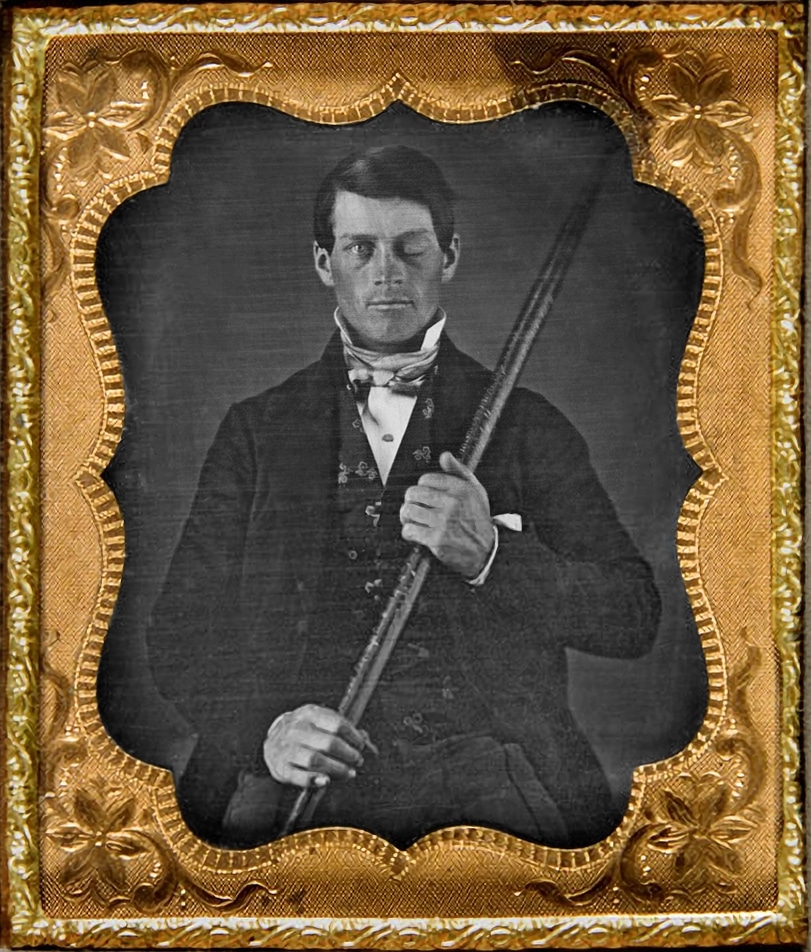
the story of a 25-year-old railroad foreman. His name was Phineas Gage. In 1848, Gage became
an unwitting subject of pathbreaking neuroscience research when a workplace accident led to an
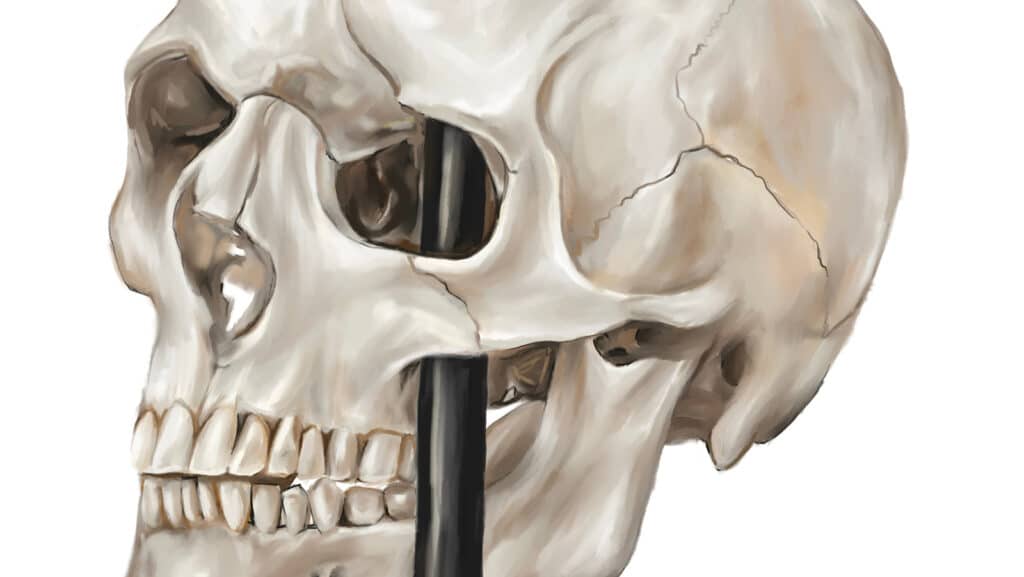
iron rod being blasted through his skull. Surprisingly, he lived to tell the tale. The tamping iron,
over three feet long and more than an inch thick, entered beneath his left cheekbone and exited
through the top of his skull. That he survived such a catastrophic injury was extraordinary. That
he walked and talked immediately after was astonishing. But what happened to Gage after the
accident, and what people thought happened, forever changed how we understand the human
brain.
On that September day in Vermont, Gage was tasked with rock blasting to lay rail lines. As he
tamped down the side of a rock, he accidentally ignited the gunpowder that was meant to blast
the rock. This led to a premature explosion, launching the iron rod like a missile. It pierced his
brain’s frontal lobe, which we now know plays a vital role in personality, decision-making, and
social behavior. As documented in the New England Journal of Medicine, he was not only awake
but reportedly quipped to a doctor, “Here is business enough for you,” while being treated.
The accident didn’t kill Gage, but it did alter him. According to his physician, Dr. John Harlow,
he went from being efficient and likable to “fitful, irreverent, and grossly profane.” Harlow
famously wrote that his friends and colleagues said Gage was “no longer Gage”. This phrase has
echoed through neuroscience literature for over a century, becoming shorthand for the idea that
damage to the frontal lobes can fundamentally change personality. Over time, this narrative took
hold: a man transformed from an upstanding citizen to an impulsive, morally compromised
shadow of himself. The story quickly became a case study of what happens when the brain’s
executive center is compromised.
But here’s the twist: much of that story has since been fabricated. As pointed out in recent
analyses, Gage was not a helpless invalid post-injury. He later worked as a stagecoach driver in
Chile, which hardly sounds like a job for someone with severe behavioral dysfunction. While
some changes in temperament were likely real in the months following the injury, they may not
have been as dramatic or permanent as early accounts claimed.
Modern reconstructions of Gage’s skull, including 3D imaging and CT scans referenced in
Frontiers in Human Neuroscience have helped clarify which brain regions were affected. These
studies support the idea that damage to specific areas of the left frontal lobe contributed to some
of the changes reported. Yet, they also suggest that Gage’s brain was remarkably adaptive,
demonstrating early evidence of what we now call neuroplasticity.
Importantly, the Phineas Gage case played a crucial role in advancing our understanding of the
brain’s localization of function. His story helped steer 19th-century medicine away from the
belief that the brain was an undifferentiated mass and toward the idea that different regions serve
different purposes. Gage’s injury and survival provided a real-life experiment in how the brain
relates to behavior, albeit a tragic and accidental one.
Still, the mythology around Gage has taken on a life of its own. As mentioned in the BMJ and
other scholarly discussions, textbooks and media often oversimplify or dramatize his story,
presenting him as a man completely unrecognizable post-injury. This kind of narrative does a
disservice not only to the truth but also to brain injury survivors today. The idea that damage
equals permanent moral collapse isn’t just misleading, it’s also harmful.
Today, Phineas Gage is more than a medical oddity. He’s a symbol of both the fragility and
resilience of the human brain. His story reminds us how much we still have to learn about the
mind, and how easily science can be shaped by storytelling. Beneath the iron and the legend lies
a real man whose life helped launch an entire field, whether or not he ever became the “grossly
profane” soul that popular culture insists he was.


